#BlogElul 16: Change

#BlogElul 2013When I was a kid, I tried to change into a unicorn.

Wait, scratch that. My best friend down the street, Deborah, and I half-convinced ourselves that we were unicorns, exiled from our magical, rainbow-filled cloud palace and trapped in awkward-human-girl form. Our real names were Crystal Prism and Crystal Lynn (oh good gracious, I never realized until just now that those names sound like they should be gyrating on a pole; I have no idea how our mothers kept straight faces), and we were locked in a struggle to unleash our true unicorn potential, change back into sparkly-hoofed equines, and return to our real home.

We wrote poems — incantations, spells designed to help us effect this change from small, boring girl to marvelous creature of myth. We rhymed “unicorn” with “true form,” which should tell you all you need to know about the verses we laboriously hunt-and-pecked out on one of the family computers.

Yes, I still have copies. No, you may not see them. They were that good.
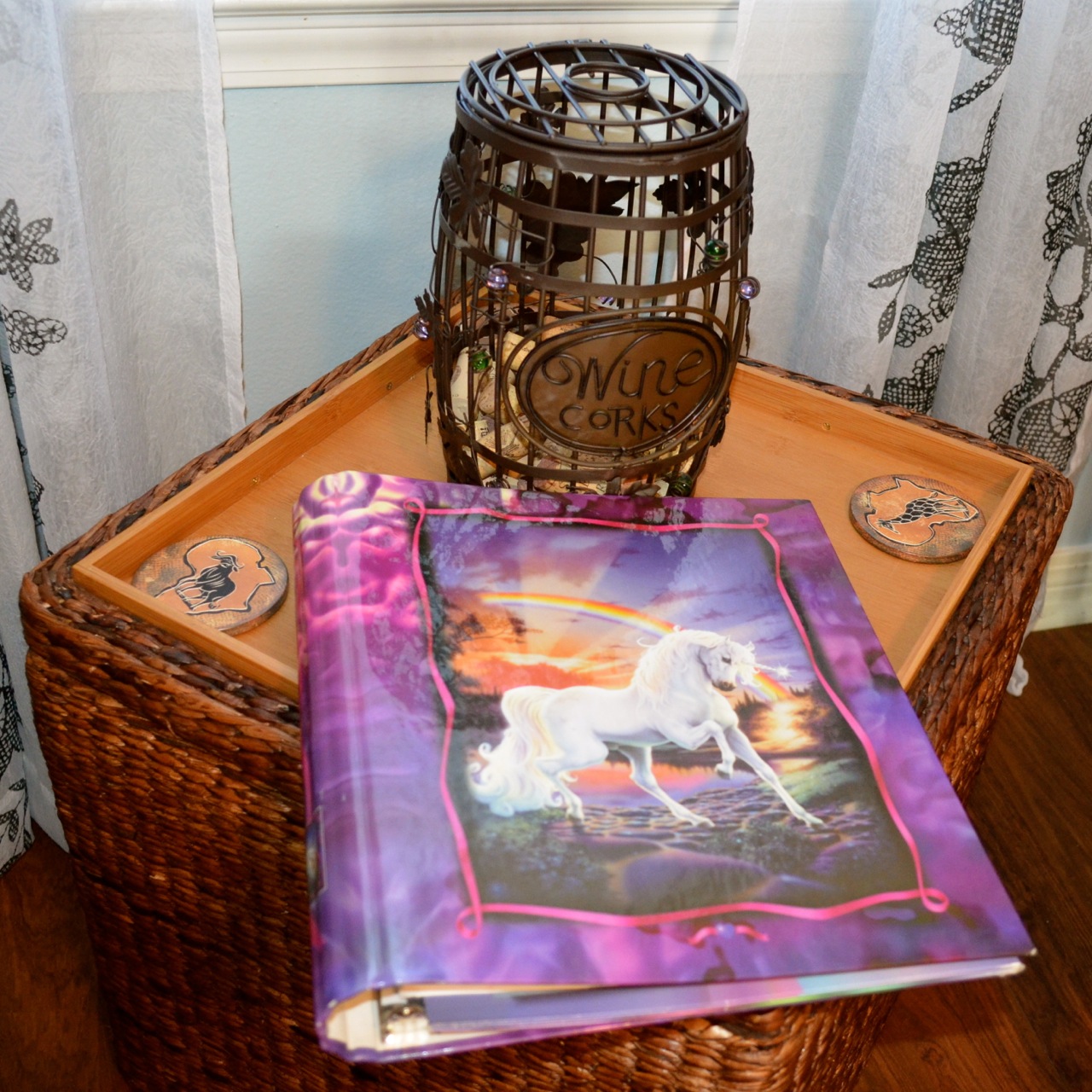
Unicorn Binder

This is the original binder containing the fruits of our childhood poetic genius. There is not enough wine in the world to get me to show you.

I’m afraid we were ultimately unsuccessful in our quest to transform ourselves into unicorns, even with the dubious assistance of a couple of crude unicorn carvings (“magical totems”) for which we eagerly forked over our allowances at the mall. Eventually, the far less glamorous change of adolescence came upon us, and we lost interest in playing Unicorns in Exile.

The thing in which I found I had not lost interest, once the tumult of puberty was behind me, was the process of change itself. The idea that we have truer, deeper selves, hidden by sometimes unsatisfying outward appearances, is an alluring one. How many times have we looked back on some action of ours, a time when we missed the mark, and said, “No, not this, that’s not the real me”? How often have we felt that others were not seeing ourselves as we truly are inside?

The month of Elul, a month of reflection and transformation, is an opportunity for me to look deep and see where there is a disconnect between my innermost heart and my actions in this world. Where there is disharmony, I need to work on getting back in tune with myself and the universe. In other words, that is where I need to do teshuvah.

I may not be able to change into a unicorn, but I can change my behavior to bring my outward face into alignment with the best parts of my inward soul. That kind of change is magic enough for me.


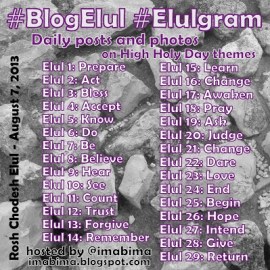
#BlogElul, the brainchild of Rabbi Phyllis Sommer, invites participants to chronicle the month leading up to the Jewish High Holy Days through blog posts, photos, and other social media expressions.


#BlogElul 15: Learn

#BlogElul 2013Say what you will (and I have, in no uncertain terms) about the hassle of frequent military moves, they do serve to keep our minds in learning mode. Our PCS from Virginia to Florida earlier this year has provided us with ample opportunity to flex our mental muscles and make new connections in our networks of neurons. We are constantly rewiring our brains to deal with our changing situation.

We started learning new things long before we packed up and left the Old Dominion, such as how to prepare a house for rental. We learned about property managers and painting and plaster repair. We learned about refinancing and paperwork and how to make zillions of trips to the hardware store to take care of zillions of little things.

When we arrived in Pensacola, we learned how to search for a rental house, which we had never done before; the process differs from finding an apartment, moving into base housing, or buying a home. We started learning the local roadmap, all the ways and back ways and shortcuts and times to avoid certain routes. We scoped out the commissary and civilian grocery stores and the local restaurant scene, which seems to have changed for the better in the seven years since my husband’s SNA days. We learned about parks and trails and beaches, places to go and be outside in our new state.

Blackwater River

We can’t wait to learn how to go tubing down the meandering, sandy-bottomed Blackwater River.

We learned about frogs and toads and anoles. We got ourselves a guidebook so we could begin to put names to unfamiliar birdsong and feather patterns in our own backyard. We learned about gigantic mosquitos.

T-6A Texan II

A T-6A Texan II, the kind of airplane my husband flies here in Florida. U.S. Navy photo by Jeff Doty (RELEASED)

My husband jumped headfirst into learning the new airplane he was to fly for this set of orders. He learned T-6A systems and checklists and emergency procedures. He made flashcards for everything, and I learned about the Texan II as I quizzed him and helped him run practice checklists in “chair-flying” study sessions.

Our new synagogue proved full of things to learn. We learned new names and faces. We learned our new rabbi’s style of leading services, and we learned new melodies for familiar prayers. We started learning our congregation’s history, its feel, its tone — its ruach, if you will. We relearned, for the first time since college Hillel and Jewish Midshipmen Club, how sweet it is to spend time with other Jews close to our own age.

We learn every day, but I know the pace of day-to-day knowledge acquisition will continue to slow as we get more and more comfortable at this duty station. In a little more than two and a half years, though, we expect that impending-move jolt to kick our brains back into their thirstiest state. We’ll learn all over again.


#BlogElul, the brainchild of Rabbi Phyllis Sommer, invites participants to chronicle the month leading up to the Jewish High Holy Days through blog posts, photos, and other social media expressions.

#BlogElul 14: Remember

#BlogElul 2013The Days of Awe are filled to the brim with trial imagery. Sin and punishment, chest-beating confessions, a Judge who is both Parent and Sovereign — all the ingredients for a compelling courtroom drama are there. If our actions are going to be on trial, it is tempting to use Elul, the time we’re supposed to spend in self-reflection, to work on our defense arguments.

One might think that God would be impatient with arguments from the likes of us. If God is omniscient, what would be the value in it? What would be the point of the following request in Isaiah?

Help me remember!

Let us join in argument,

Tell your version,

That you may be vindicated. (Isaiah 43:26)

I don’t think it is the Eternal’s memory that needs refreshing. Mine almost certainly does, however, and there is nothing quite like an invitation to explain how I was right and justified in everything I did this year to get the gears of memory cranking. When I start unpacking my words and deeds to state my case, though, I run into trouble. I find my well-honed arguments trailing off as I see how shaky some of my excuses really are.

It would be easier, in some ways, to fling my defense in the face of an unrelenting Accuser. When I feel under attack, the walls of self-righteousness go up by reflex; there is no way I will admit even the possibility that I could have been wrong. There is a way around my instinctive barricade, though, and the One who professes to need help remembering has it all figured out. The One who speaks in Isaiah 43:26, rather than confronting me with all my shortcomings, solicits my side of the story and patiently waits for me to see the holes in my own rationalization.

Only then, when I see for myself how self-serving my memory can be, is there the possibility for my vindication through teshuvah, through turning and repentance and atonement.


#BlogElul, the brainchild of Rabbi Phyllis Sommer, invites participants to chronicle the month leading up to the Jewish High Holy Days through blog posts, photos, and other social media expressions.

#BlogElul 13: Forgive

#BlogElul 2013I first read Rabbi Alan Lew’s This Is Real and You Are Completely Unprepared: The Days of Awe as a Journey of Transformation during last year’s run-up to the High Holy Days, and I’m reading it again this year. The version I have is an ebook, which means that I felt free to do something I cannot bring myself to do with printed books: highlight passages that spoke to me in some way. (I cringe at the thought of dog-eared pages and scribbled notes in the margins, and I fully accept my own peculiarity on this score.)

This year, as I read, I occasionally run across a section of text I electronically highlighted during my first reading a year ago. It’s interesting to see if a particular passage jumps out at me as strongly this year as it did in my first reading. Here’s one that still has something to say to me today:

Forgiveness, it has been said, means giving up our hopes for a better past. This may sound like a joke, but how many of us refuse to give up our version of the past, and so find it impossible to forgive ourselves or others, impossible to act in the present?

A hope for a better past… I know I indulge in such revisionist-history fantasies every once in a while. (Okay, probably more than just once in a while.) While in the midst of that kind of reverie, the kind where all the “if-onlies” come out to play and lead to a better conclusion, or at least a conclusion in which I come out looking better, there is a kind of satisfaction. Our memories are more malleable than we’d like to admit. The question is, is it worth my time to sit down, roll up my mental sleeves, and spend my energy sculpting a vision of the way things “should” have been?

Or should I instead leave the past alone, unpolished by self-justification, and walk forward? I know I will miss the mark sometimes and need to ask forgiveness, and I know people will need to ask for mine. With such a journey ahead of me, who has time to worry about what cannot be changed except in imagination?


#BlogElul, the brainchild of Rabbi Phyllis Sommer, invites participants to chronicle the month leading up to the Jewish High Holy Days through blog posts, photos, and other social media expressions.

#BlogElul 12: Trust

#BlogElul 2013As the storm that had prematurely awoken us this morning growled and raged about us, I mentioned to my husband that today’s theme for that Elul blogging project is trust.

“Well,” he said thoughtfully between bites of (insanely delicious, decadent) churro waffle, “I trust the aircraft maintainers with my life every time I go flying.”

There are times I can almost forget that my husband’s job is a little unusual. I kiss him goodbye in the morning, tell him I love him, and say, “Have a good flight. Let me know when you land so I can start preheating the oven.” I send him out the door and go about my day without really thinking about the risks inherent in a naval aviator’s job. Just about anything will start to feel normal after a while, including the fact that my husband’s “office” has an ejection seat.

Every now and then, something — such as an offhand remark over breakfast — will remind me that military aviation isn’t a desk job.

The man I love most in this world relies upon the men and women who turn the wrenches, whose clothes are smeared with every kind of fluid an aircraft can possibly bleed, who work night and day to chase down gripes and keep these complex, often persnickety machines ready to perform the missions demanded of them. My husband places his trust in these maintainers, and he proves that trust by strapping into the aircraft, shutting the canopy, and taking to the sky.

I have not met most of the men and women in whom my husband, his fellow pilots, and the students yearning toward their Wings of Gold place their faith, but I, too, must trust them. Although I am not personally betting my own life on their maintenance of the aircraft, I am depending on their work for the safety of one I hold most dear.

Trusting others, particularly through some strange transitive property of faith, is not easy. I have to trust people I have never met, whose work or skill I have no means of personally verifying. I wonder if they ever stop and think about how many people — spouses, children, mothers, fathers — trust them implicitly. I hope they don’t think about it too often, though; the responsibility is awesome, and perhaps too distracting to bear in mind all the time and still be able to function.

I think it is good for all of us to sit for a while, now and again, and allow ourselves to feel the weight of trust upon our shoulders. Chances are, there are people we’ve never met who have placed their trust in us. I hope I am worthy of it.


#BlogElul, the brainchild of Rabbi Phyllis Sommer, invites participants to chronicle the month leading up to the Jewish High Holy Days through blog posts, photos, and other social media expressions.