Guest Post: Welcome to Cruise

Military spouses occupy a curious corner of the greater military blogging constellation. I could sit here all day and tell you all about what it’s like to be married to a nasal radiator naval aviator. I could give a first-hand account of deployment from the homefront perspective. I could tell you all about my husband’s aircraft, its mission, and even rattle off immediate action items from the emergency procedures checklists. We spouses tend to absorb quite a bit of information through osmosis.

What I cannot tell you, however, is what it feels like to fly the beast, to land it on a pitching deck, and to spend months bouncing from foreign base to foreign base in order to stay within reach of the aircraft carrier relying on its CODs for cargo, mail, and transport of important personnel. For that, you need to ask my husband. He has graciously offered to share a vignette that captures a moment those of us who wait at home do not get to see: the instant that deployment truly begins.

“Last Minute” by Sampson
Aircraft carriers leave little margin for error. (U.S. Navy photo by Mass Communication Specialist 2nd Class James R. Evans/Released)

Somewhere in the back of your airplane, Petty Officer Jones is saying his Hail Marys. It’s a strange thing for a man that scared of flying and ships to be in a COD squadron. Yet, here he is, and here you are, flying from the left seat in one of two mighty C-2A Greyhounds. In addition to forty- something enlisted aircraft maintainers, they are stuffed to the gills with everything your COD detachment will need for the next six months supporting a carrier air wing.

Well, okay, the birds don’t have everything you’ll need. Five people are waiting to catch a ride on a C-130 across the pond to start setting up the first Forward Logistics Site. The good news is that’s five fewer days stuck on a boat. The bad news is none of them are about to bag a trap.
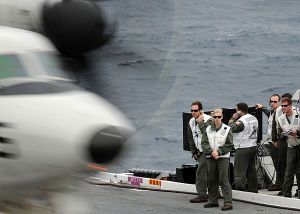
LSOs guide aircraft in for safe landings. (U.S. Navy photo by Mass Communication Specialist 3rd Class Brent Thacker/Released)

The boat is still close offshore. She is steaming conspicuously westerly, into the rapidly setting sun. In half an hour, you’ll make like Cinderella’s carriage and turn into a pumpkin. But, good news! The deck is expecting you. Your signal is “buster”, which is boat-speak for keep your foot on the floor, and expect “Charlie on arrival”, which means you should recover immediately.

You follow behind your detachment’s other aircraft. As you set up for your entry into the pattern, you can’t help but notice the sun sitting just above and to the left of the ship’s landing area. This could get interesting. Sure enough, rolling into the groove, the ball is barely visible – and it is low. Power on, you’re afraid to actually scan angle of attack and lineup lest you lose glideslope reference. The niggling detail that this ship has had the third of four wires normally on the flight deck stripped enters unwelcome into your brain.
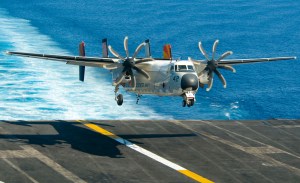
Arrested Landing

A C-2A Greyhound makes an arrested landing. (U.S. Navy photo by Mass Communication Specialist Seaman Rosa A. Arzola/Released)

When you take an arrested landing, one of two things happen: you stop fairly quickly or the LSOs call out “Bolter, bolter bolter” almost immediately. Not today. WHUMP, you are on deck, one potato, two potatoes, three potatoes, and at last, there’s that blessed deceleration. In a couple of hours, the LSO will explain that your hook skipped over the second wire but snagged number four, hence the three eternities on the landing rollout.

But right now none of that matters. You taxi the bird out of the landing area, fold the wings, and shut her down for the ride across the Atlantic. The aircraft commander turns to you and shakes your hand.

“Nice trap. Welcome to cruise.”

The ship is pointed conspicuously eastward…

From Alpha to Zulu

Miltary Life from Alpha to ZuluWife on the Roller Coaster threw down the proverbial gauntlet last week with a challenge: outline your military life from A to Z — or in the phonetic alphabet, Alpha to Zulu. Mine grew somewhat in the telling from a list of words to a compendium of definitions that largely turned out to be specific to the Naval Aviation community. I had fun with it, and I can’t wait to see what other military spouses come up with for their abridged dictionary versions of military life.

Got your own list? Go forth and link up at Riding the Roller Coaster!

Alpha to Zulu (Naval Aviation Style)

Alpha is for airshows, which not only play a great role in military recruiting and awareness in the community, but also make for some sweet-deal cross-country flights.

Bravo is for Boat, what aviators call the aircraft carrier to irritate the shoes (see “Sierra” below) who think it ought to be called a ship.

Charlie is for Carrier Onboard Delivery, the mission of my husband’s aircraft.

Delta is for debrief, the post-flight play-by-play that includes, if you were landing on the carrier or practicing to do so, the grades of your passes by the LSO (see “Lima” below).

Echo is for EPs, the aircraft Emergency Procedures that must be memorized so they can be put into action at a moment’s notice. Many spouses of flight students become well-versed in EPs through quizzing their loved ones.

Foxtrot is for flight schedule, AKA the “Sked,” which rules each day of our lives and doesn’t come out for until the evening before.

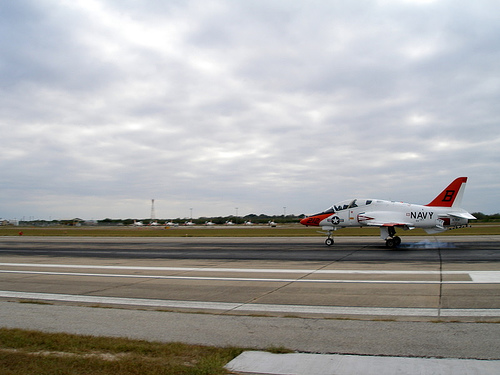
GoshawkGolf is for the T-45 Goshawk, the jet trainer in which my husband made his first carrier landing.

Hotel is for Hail and Bail, a party during which we greet the FNGs (Fu… uh, “Fine” New Guys/Gals) and say goodbye to those moving on to the next assignment.

India is for IP, or Instructor Pilot. When you’re in flight school, you live and die on how the IPs grade you.

JOPA PatchJuliet is for JOPA, the unofficial Junior Officer’s Protection Association made up of the squadron’s O-1s, O-2s, and O-3s. JOPA must stick together under the occasional onslaught of “great ideas” of O-4s and above.

Kilo is for Kingsville, Texas, our first home as a married couple (and a place we would not have chosen to live without the Navy’s insistence that flight school take place in a part of the country with lots of empty airspace).

Lima is for LSO, or Landing Signal Officer. Also called “Paddles,” this is the guy or gal who stands on the platform to help pilots land aboard the carrier and grade their landings.

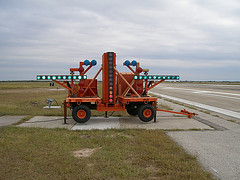
MeatballMike is for meatball, the Fresnel lens glideslope indicator that tells pilots whether they’re coming in for a carrier landing correctly. If you’ve heard someone talking about “calling the ball,” this is what they mean.

November is for NATOPS, the Naval Air Training and Operating Procedures Standardization program. This thick tome contains as much as it is humanly possible to know about flying a given aircraft, and it is often said to have been “written in blood.”

Oscar is for ORM, or Operational Risk Management, which imbues both our Navy and Civil Air Patrol activities.

Papa is for PCLs, the pocket checklists for each aircraft my husband flew in flight school that litter our house to this day.

Quebec is for the Q, whether it refers to Bachelor Officers’ Quarters, Bachelor Enlisted Quarters, or Combined Bachelor Quarters. We’ve lived in one Q or another whilst looking for permanent housing at a new duty station.

Romeo is for ready room, an environment in which one had better have a thick skin; aviators aren’t known to be Mister Rogers-esque paragons of gentleness in their speech or mannerisms.

Sierra is for shoe, short for “blackshoe” — a Surface Warfare type. Only aviators wear brown shoes in uniform.

Tango is for tailhook, without which carrier landings would be well-nigh impossible for fixed-wing aviators.

Uniform is for underway. Even when my husband is at home, he is busy flying out to support any carrier that is underway within reach of this coast.

Victor is for the VTs, as in VT-6 or VT-3, the Navy’s fixed-wing training squadrons. Contrast with the HTs, the helicopter training squadrons.

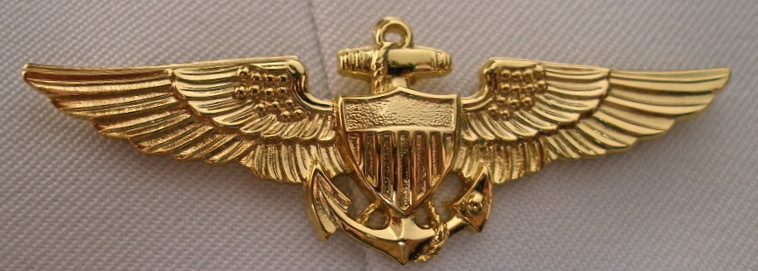
Whiskey is for Wings of Gold. Whether double-anchor (for Naval Flight Officers — think “Goose” from Top Gun) or single-anchor (for Naval Aviators, the pilots), earning one’s wings is a proud accomplishment following an arduous passage through flight school.

X-Ray is for the X. “Getting the X” means completing the syllabus flight, not always an easy task in flight school, when so many things are dependent on the weather or having an up (functional) airplane available.

Yankee is for “You fool!” — what you are if you expect military life to make sense all the time.

Zulu is for “zipper-suited sun god,” a tongue-in-cheek appellation for those who spend most of their time in flight suits.

MilSpouse Friday Fill-In #30

What is your favorite MilSpouse blog (not including Wife of a Sailor who we all love, or your own)? –submitted by Our Crazy Life

Now, now, it’s not nice to play favorites. 😉 I’ll give what might be perceived as a cop-out answer and say SpouseBUZZ is pretty cool because of the variety of viewpoints it offers. SpouseBUZZ was one of the very first milspouse blogs I added to my RSS reader several years ago, back before I kept my own milspouse blog or really sought out others’.

What are your favorite perks about your s/o being deployed (we all know there are perks)? —submitted by Ramblings of a Marine Wife

One thing I have savored is not having to live my life by the flight schedule. We have no idea what my husband will be doing the next day until the flight schedule goes out the evening before. Until that point, we don’t know if we’re looking at an oh-dark-thirty wake-up for an early brief or if he’ll overshoot a reasonable dinnertime by hours due to a night bounce (Field Carrier Landing Practice, or FCLP) session. My hours are much more regular when Sampson is away; I imagine it will be a bit of an adjustment to get used to planning around the flight sked again when he returns home.

How long did you date your <significant other> before getting engaged? Married? –submitted by Utterly Chaotic

We had been dating for about four and two-thirds years when Sampson proposed. We initially thought our engagement would be about a year and a half long, but due to the exigencies of flight school, we wound up getting married just a few days shy of one year after he proposed.

What do you think your <significant other> would do if s/he wasn’t in the military? –submitted by Adventures of M-Squared

We’ve talked about this “parallel universe” scenario from time to time. I think we would find ourselves living close to our Northern Virginia roots while Sampson worked as an aerospace engineer for one of the big government contractors. It’s possible that I would be working for the same one as a software engineer.

I think one of the main things that kept Sampson from going that route was the knowledge that if he didn’t even try to make his childhood dream of being a Naval Aviator a reality, he would live the rest of his life wondering what might have been. The fact of the matter is that one can pursue a career in engineering after a career as a military pilot, but the reverse is not true. Some things must be done in youth or not at all.

If you could talk to the Secretary of (fill in your appropriate branch) what is one suggestion you would like to bring to their attention in order to improve the lives of military families? —submitted by My Life as His (Air Force) Wife

I don’t know about the lives of military families in general, but it would set this Navy family’s collective mind at ease to have confidence that those in the upper echelons understand the difference between sustainable, well-supported efforts and temporary, extraordinary measures to get the job done in a pinch. None of us can function interminably at “in a pinch” levels.


Are you a military spouse/fiancée/fiancé/girlfriend/boyfriend? Hie thee to ENS Wifey’s blog, snag the questions, and add yourself to the Mr. Linky for this week’s MilSpouse Friday Fill-In!

Supplies Party

In the days before Sampson* departed for this deployment, I was at a bit of a loss as to what I was supposed to do to get myself ready. Oh, we had already taken care of the concrete stuff: my military ID was renewed, the base stickers on my car were updated, we had our powers of attorney and all that good stuff. Sampson was busy at work right up until the day he left, so I had a lot of time on my hands at home with the departure date hanging over my head and not a lot of substance I could do to prepare myself.

One thing I did find to do was make a phone call to the United States Postal Service and request a military care package kit. I hate talking on the phone with strangers, so it took some mental wherewithal to get myself psyched up for waiting on hold until I reached a person, but I am very glad I did. The request was easy to make, and the kind lady with whom I spoke assured me the assortment of boxes and other shipping supplies would arrive in a couple weeks.

It felt good to do something — even a small something — to make me feel I was in control of at least one aspect of the upcoming deployment. I might not have known much, but darn it, I knew for sure how I was going to deal with putting packages together for my husband! Bonus, I got to look forward to the arrival of the kit on my doorstep, which got me looking past the looming goodbye.

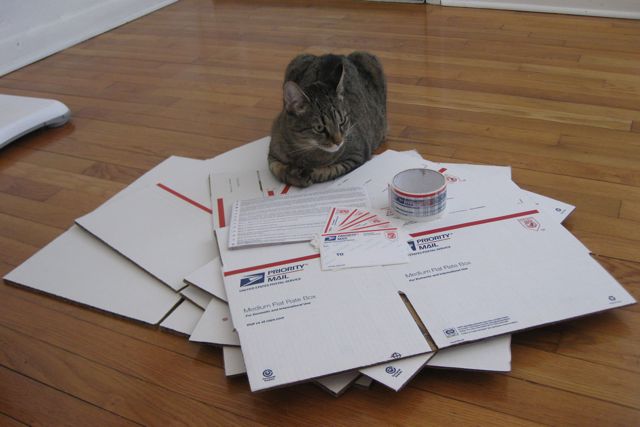
Cat and carboard boxes

Vera is ready to assist, if by "assist" we mean "hinder in any way possible, up to and including getting cat hair stuck on every bit of tape."

It really is a comprehensive kit: assorted Priority Mail flat-rate boxes, address labels, customs forms, the little plastic sleeves for said customs forms, and even a little roll of Priority Mail tape to tie everything together. Everything arrived on my doorstep, neatly wrapped and at no cost to me. Of course, I will still need to pay postage to actually mail the packages, which is no doubt a big part of why the USPS is so happy to give us the kits gratis.

If you are a family member or friend of someone in the military, call up 1-800-610-8734 and ask for the Military Care Kit. All you have to do afterward is dream up wonderful things with which to fill those boxes before you mail them off to make your servicemember’s day.

_____

* Sampson: I finally bestowed upon my husband a bloggish alias, so I need not awkwardly refer to him as “my husband” every time I mention the guy.

New Year, New… Socks?

Once upon a time, I was not a knitter. (Bet you didn’t know  “once upon a time” meant “last summer,” did you?) With the help of a scrying pool that suspiciously resembled my MacBook, I studied the lore of needles, knits, and purls. With much trial and error was this arcane knowledge won, and with each error I expanded my vocabulary of, ah… magic words of the sort with which Sailors (and *cough* some of their wives, apparently) pepper their speech and mothers attempt to keep from the tongues of their babes.

I have knit long scarves, lace dishcloths, and cabled hats. I have knit woolly fingerless mitts and Navy uniform-spec watch caps. I have knit for myself and for gifts and for no real reason at all. While by no means a master of the craft, I believe I am vanishingly close to being able to claim the title of sorceress Knitter, with a capital ‘K.’

Only one thing stands in my way of my own self-perception of knitting accomplishment: a pair of socks.

For reasons obscure even in my own mind, I will not feel I have truly arrived in the knitting world until I complete my first pair of socks. For me, hand-knit socks carry a cachet that outstrips the apparent humbleness of a couple of modified tubes into which one jams one’s chilly feet. You knit and purl and knit and purl forever. Then, screwing up your courage, you perform the mysterious rite known as “turning the heel,” which to me really does appear to be a magic spell one casts with wands shaped like double-pointed needles. Then you knit some more, conjuring up something called a “gusset,” and before you know it, there sits before you a sock where once was only a ball of yarn.

I’m still in the “knit and purl forever” phase of my first sock.

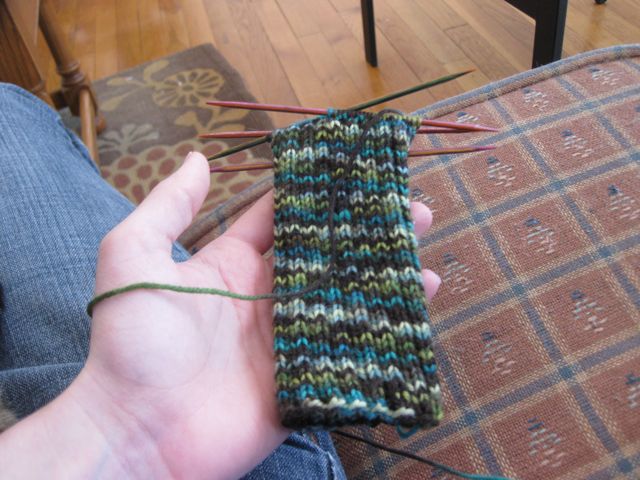
Sock cuff, with many stabbity needles.

Two-by-two ribbing, on and on and on.

I am a little concerned that I might just keep knitting the cuff forever, for fear that I will thoroughly embarrass myself with a pitiful first attempt at turning the heel. Things might progress a wee bit faster, however, if I had a mite less “help” from the feline contingent.

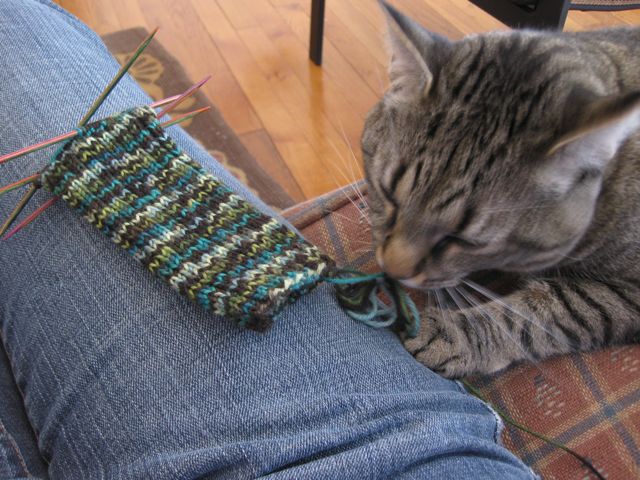
Cat noms yarn. Yum.

Vera's possession of four paws does little to help her manipulate four DPNs, so she prefers to snack on the raw material instead.

Actually, I feel fairly well prepared (thanks to Silver’s Sock Class) to turn the heel and make a go at finishing Sock the First. It’s Sock the Second that worries me. After the sense of accomplishment that comes from learning the skills necessary to complete the first, will the lack of novelty make the second an exercise in drudgery? Will I be whining, “But I just did this. I don’t want to do it again yet!”

Come to think of it, I have the same questions about deployment. We are in the early days of our first one, and I can’t help but wonder if the fact that I don’t really know what to expect is a blessing. I have yet to experience the kinds of things that can go wrong, so I can focus on the novel aspects of this type of separation. I wonder if it hasn’t quite sunk in yet that I really and truly will not have my husband home with me for several months. I fear that after we get through all the new challenges this deployment will present, after the joyful rush of homecoming and after the comfortable routine of having our family on one continent again, that the inevitable preparations for his second deployment will be all the more difficult. I’ll know what I’m in for, and it won’t even be shiny and new.

All those are worries based on borrowed trouble, of course, and are probably best saved for later. Meanwhile, I need to get a move on if I want to have a completed pair of handmade socks to show off before we get too far into this deployment.