Dets, Deployment Cycles, and Drinking with the Squadron

COD Prepares for Launch

Should wives at home be left out of squadron fun just because the guys are deployed? (U.S. Navy photo by Mass Communication Specialist 3rd Class Benjamin Crossley/Released)

Most Navy squadrons deploy as units, with everyone from the skipper on down heading out and returning together. Sampson’s squadron operates a little differently. When a carrier deploys, along goes a COD detachment of two aircraft, six pilots, and a few dozen aircrew and maintenance personnel to support the logistical needs of the Boat throughout its time at sea. There is almost always at least one more detachment, or “det,” out supporting a different carrier, and the rest of the CODs and personnel are at home both getting ready to deploy and providing logistics hits to any carrier that happens to be operating within reach of the coast.

The consequence of this det-based structure is that there is never a time when the whole squadron is together or at the same point in the operational/deployment cycle. Some folks are getting ready to go out, some are in the middle of a deployment, some just got home, and some are in the thick of home guard ops while they wait to be assigned to a det and start preparations for the next deployment. As complicated as the who’s-home-and-who’s-gone calculus must be for Sampson and his squadronmates, it’s no less confusing on the spouses’ side.

In most squadrons, the wives left at home during a deployment can turn to any other wife and know that she is on the same timeline. They more than likely said goodbye to their husbands on the same day, and they have the same number of months/weeks/days left in the homecoming countdown. They reach milestones like the halfway point together, and might celebrate with a joyous night on the town with nearly all the other spouses. Deployment is an experience shared amongst all the spouses.

In COD land, only a small fraction of the squadron is on the same timeline that we are. When our det celebrates its halfway point, we’ll certainly invite all the spouses, and some number from outside our det will attend, but it will only be a milestone for a few of us. The wives whose husbands are home naturally want to spend time with their mates, so they might be less interested in wives-only socializing.

When Sampson is home, I know I tend to drift away from spouses’ club events in favor of those we can attend as a couple: the Hail and Bails, the Dining Outs, the occasional JOPA dinner and DRINKEX. These are the times I get to know Sampson’s colleagues: the buddies about whom I’ve heard crazy deployment stories, the superiors who attempt to keep JO exuberance in line, and the “Fu… er, Fine New Guys” coming to the squadron fresh from flight school. I love getting to know the people with whom Sampson works. Being able to put faces to the names that come up when he’s talking about work helps me build a picture that makes me feel more connected to Sampson, the squadron, and the Navy.

When Sampson left for last year’s deployment, it was like someone flipped a switch. Our husbands were gone, so we were forgotten as far as the squadron’s social life was concerned. Sure, there were FRG meetings and spouses’ club events, but information about Hail and Bails and JOPA get-togethers somehow never made it to us. Our husbands weren’t there in the ready room to receive the information and pass it along to us, so we never got it. In six months, I saw neither hide nor hair of Sampson’s fellow active duty pilots. Sometimes I’d hear from the wives whose husbands were home about this or that social event to which we would have been welcome, but no one remembered to get the memo to us wives whose husbands were away.

I am pleased to note that this oversight seems to have been resolved between last year’s deployment and this one. The command is doing a great job of keeping all spouses — not just the ones whose other halves are home — in the loop for upcoming events by passing along information through email instead of just assuming that the guys will get the info at work and pass it along when they get home. We found out about the most recent Hail and Bail in plenty of time to make plans to attend (to include finding a babysitter for those with kids) if we so desired.

Thanks to the encouragement and planning of one of my fellow det wives, three of us with deployed husbands did wind up going to partake of the open bar as we greeted the FNGs and said farewell to those moving on to the next set of orders. We were made to feel welcome in spite of the absence of our husbands — the skipper even thanked us specifically for coming out in his remarks at the start of the hailing and bailing. Instead of sitting at home feeling invisible and forgotten, we got to catch up with friends and meet new people. Oh, and laugh.  A lot. I like to think that I even helped Sampson feel more connected to the stateside squadron scene when I related some hilarious moments to him via Skype the next day.

If you are ever in a position to wonder if you ought to attend a military social function without your spouse, I suggest that you at least consider gathering a few other wives who are in the same boat and going together. Unit dynamics vary as to what might seem weird, of course, but it was a pleasant and natural-feeling experience for us. I believe that the fact that we’re being kept in the loop for more than FRG events bodes well for keeping feelings of isolation from the squadron “family” at bay throughout this deployment.

I Pick… That One!

About a week and a half ago, I decided that the house had been feeling a little empty for the past six months. I decided that I would head over to the squadron and see if some handsome pilot wanted to come home with me.

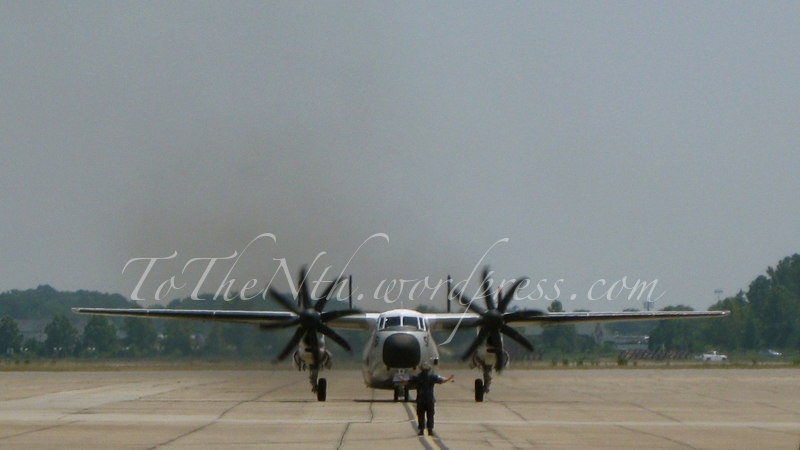
Homecoming COD

Moreover, I decided that I'd pick one getting off this very airplane, which had just completed a very impressive flyover of the hangar.

Out of all the folks in flightsuits there, I think I picked a good one to liven up the house again. Vera and Val even like him! Well, they like all the stuff he brought home to sniff and sleep upon, which is pretty much the same thing as fondness for cats.

Sampson is home, and all feels a little more right with my world. As he went back to work just a couple days after making his triumphant return, we’re still waiting on our summer vacation/homecoming honeymoon leave. There are still some (read: all) details to work out, but we are hoping to escape to a cabin in the mountains to enjoy some cooler temperatures and some time to ourselves. When we’re close to base, it’s all too easy for the squadron to call up with some crisis or other that requires Sampson’s immediate attention. Such is the homeguard life, I suppose.

We have several exciting new ventures planned closer to home, too, and I’m excited to share them with you all even as I share the experiences with the love of my life, my best friend in the whole world, and the guy who — luckily for him! — just happened to look best in his flightsuit on the day I decided I simply wasn’t going home without a pilot.

If EMALS Can Handle the COD…

…the experimental EMALS (Electromagnetic Aircraft Launch System) might be on its way to handling anything. Maybe.

I must admit, I’m sharing this video mostly to show some C-2A Greyhound love, but it’s pretty neat how quiet EMALS is. Steam catapults will no doubt be around for some time yet, though.

Guest Post: Welcome to Cruise

Military spouses occupy a curious corner of the greater military blogging constellation. I could sit here all day and tell you all about what it’s like to be married to a nasal radiator naval aviator. I could give a first-hand account of deployment from the homefront perspective. I could tell you all about my husband’s aircraft, its mission, and even rattle off immediate action items from the emergency procedures checklists. We spouses tend to absorb quite a bit of information through osmosis.

What I cannot tell you, however, is what it feels like to fly the beast, to land it on a pitching deck, and to spend months bouncing from foreign base to foreign base in order to stay within reach of the aircraft carrier relying on its CODs for cargo, mail, and transport of important personnel. For that, you need to ask my husband. He has graciously offered to share a vignette that captures a moment those of us who wait at home do not get to see: the instant that deployment truly begins.

“Last Minute” by Sampson

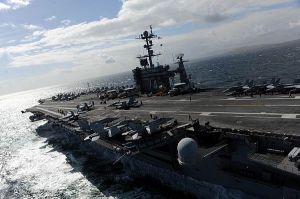
Aircraft carriers leave little margin for error. (U.S. Navy photo by Mass Communication Specialist 2nd Class James R. Evans/Released)

Somewhere in the back of your airplane, Petty Officer Jones is saying his Hail Marys. It’s a strange thing for a man that scared of flying and ships to be in a COD squadron. Yet, here he is, and here you are, flying from the left seat in one of two mighty C-2A Greyhounds. In addition to forty- something enlisted aircraft maintainers, they are stuffed to the gills with everything your COD detachment will need for the next six months supporting a carrier air wing.

Well, okay, the birds don’t have everything you’ll need. Five people are waiting to catch a ride on a C-130 across the pond to start setting up the first Forward Logistics Site. The good news is that’s five fewer days stuck on a boat. The bad news is none of them are about to bag a trap.

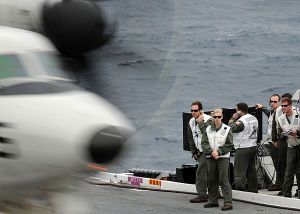
LSOs guide aircraft in for safe landings. (U.S. Navy photo by Mass Communication Specialist 3rd Class Brent Thacker/Released)

The boat is still close offshore. She is steaming conspicuously westerly, into the rapidly setting sun. In half an hour, you’ll make like Cinderella’s carriage and turn into a pumpkin. But, good news! The deck is expecting you. Your signal is “buster”, which is boat-speak for keep your foot on the floor, and expect “Charlie on arrival”, which means you should recover immediately.

You follow behind your detachment’s other aircraft. As you set up for your entry into the pattern, you can’t help but notice the sun sitting just above and to the left of the ship’s landing area. This could get interesting. Sure enough, rolling into the groove, the ball is barely visible – and it is low. Power on, you’re afraid to actually scan angle of attack and lineup lest you lose glideslope reference. The niggling detail that this ship has had the third of four wires normally on the flight deck stripped enters unwelcome into your brain.

Arrested Landing

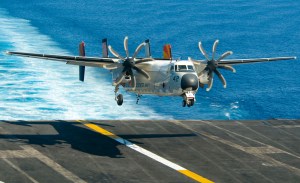
A C-2A Greyhound makes an arrested landing. (U.S. Navy photo by Mass Communication Specialist Seaman Rosa A. Arzola/Released)

When you take an arrested landing, one of two things happen: you stop fairly quickly or the LSOs call out “Bolter, bolter bolter” almost immediately. Not today. WHUMP, you are on deck, one potato, two potatoes, three potatoes, and at last, there’s that blessed deceleration. In a couple of hours, the LSO will explain that your hook skipped over the second wire but snagged number four, hence the three eternities on the landing rollout.

But right now none of that matters. You taxi the bird out of the landing area, fold the wings, and shut her down for the ride across the Atlantic. The aircraft commander turns to you and shakes your hand.

“Nice trap. Welcome to cruise.”

The ship is pointed conspicuously eastward…

From Alpha to Zulu

Miltary Life from Alpha to ZuluWife on the Roller Coaster threw down the proverbial gauntlet last week with a challenge: outline your military life from A to Z — or in the phonetic alphabet, Alpha to Zulu. Mine grew somewhat in the telling from a list of words to a compendium of definitions that largely turned out to be specific to the Naval Aviation community. I had fun with it, and I can’t wait to see what other military spouses come up with for their abridged dictionary versions of military life.

Got your own list? Go forth and link up at Riding the Roller Coaster!

Alpha to Zulu (Naval Aviation Style)

Alpha is for airshows, which not only play a great role in military recruiting and awareness in the community, but also make for some sweet-deal cross-country flights.

Bravo is for Boat, what aviators call the aircraft carrier to irritate the shoes (see “Sierra” below) who think it ought to be called a ship.

Charlie is for Carrier Onboard Delivery, the mission of my husband’s aircraft.

Delta is for debrief, the post-flight play-by-play that includes, if you were landing on the carrier or practicing to do so, the grades of your passes by the LSO (see “Lima” below).

Echo is for EPs, the aircraft Emergency Procedures that must be memorized so they can be put into action at a moment’s notice. Many spouses of flight students become well-versed in EPs through quizzing their loved ones.

Foxtrot is for flight schedule, AKA the “Sked,” which rules each day of our lives and doesn’t come out for until the evening before.

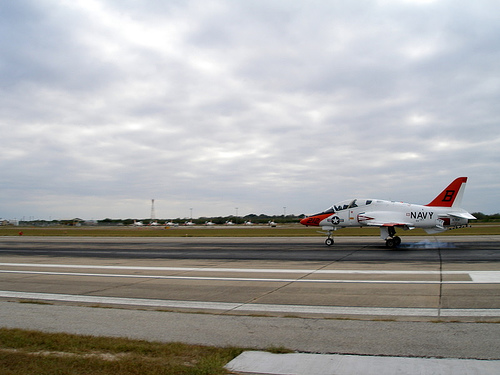
GoshawkGolf is for the T-45 Goshawk, the jet trainer in which my husband made his first carrier landing.

Hotel is for Hail and Bail, a party during which we greet the FNGs (Fu… uh, “Fine” New Guys/Gals) and say goodbye to those moving on to the next assignment.

India is for IP, or Instructor Pilot. When you’re in flight school, you live and die on how the IPs grade you.

JOPA PatchJuliet is for JOPA, the unofficial Junior Officer’s Protection Association made up of the squadron’s O-1s, O-2s, and O-3s. JOPA must stick together under the occasional onslaught of “great ideas” of O-4s and above.

Kilo is for Kingsville, Texas, our first home as a married couple (and a place we would not have chosen to live without the Navy’s insistence that flight school take place in a part of the country with lots of empty airspace).

Lima is for LSO, or Landing Signal Officer. Also called “Paddles,” this is the guy or gal who stands on the platform to help pilots land aboard the carrier and grade their landings.

MeatballMike is for meatball, the Fresnel lens glideslope indicator that tells pilots whether they’re coming in for a carrier landing correctly. If you’ve heard someone talking about “calling the ball,” this is what they mean.

November is for NATOPS, the Naval Air Training and Operating Procedures Standardization program. This thick tome contains as much as it is humanly possible to know about flying a given aircraft, and it is often said to have been “written in blood.”

Oscar is for ORM, or Operational Risk Management, which imbues both our Navy and Civil Air Patrol activities.

Papa is for PCLs, the pocket checklists for each aircraft my husband flew in flight school that litter our house to this day.

Quebec is for the Q, whether it refers to Bachelor Officers’ Quarters, Bachelor Enlisted Quarters, or Combined Bachelor Quarters. We’ve lived in one Q or another whilst looking for permanent housing at a new duty station.

Romeo is for ready room, an environment in which one had better have a thick skin; aviators aren’t known to be Mister Rogers-esque paragons of gentleness in their speech or mannerisms.

Sierra is for shoe, short for “blackshoe” — a Surface Warfare type. Only aviators wear brown shoes in uniform.

Tango is for tailhook, without which carrier landings would be well-nigh impossible for fixed-wing aviators.

Uniform is for underway. Even when my husband is at home, he is busy flying out to support any carrier that is underway within reach of this coast.

Victor is for the VTs, as in VT-6 or VT-3, the Navy’s fixed-wing training squadrons. Contrast with the HTs, the helicopter training squadrons.

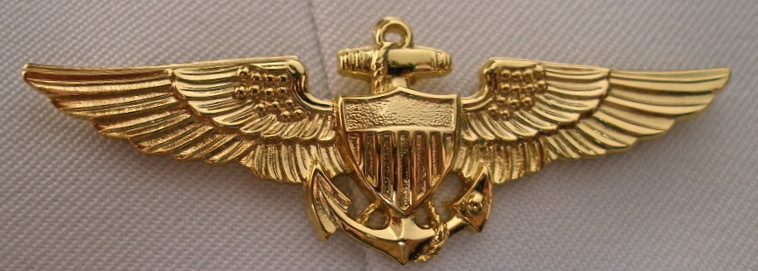
Whiskey is for Wings of Gold. Whether double-anchor (for Naval Flight Officers — think “Goose” from Top Gun) or single-anchor (for Naval Aviators, the pilots), earning one’s wings is a proud accomplishment following an arduous passage through flight school.

X-Ray is for the X. “Getting the X” means completing the syllabus flight, not always an easy task in flight school, when so many things are dependent on the weather or having an up (functional) airplane available.

Yankee is for “You fool!” — what you are if you expect military life to make sense all the time.

Zulu is for “zipper-suited sun god,” a tongue-in-cheek appellation for those who spend most of their time in flight suits.