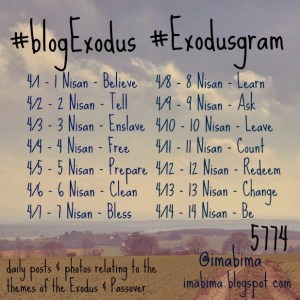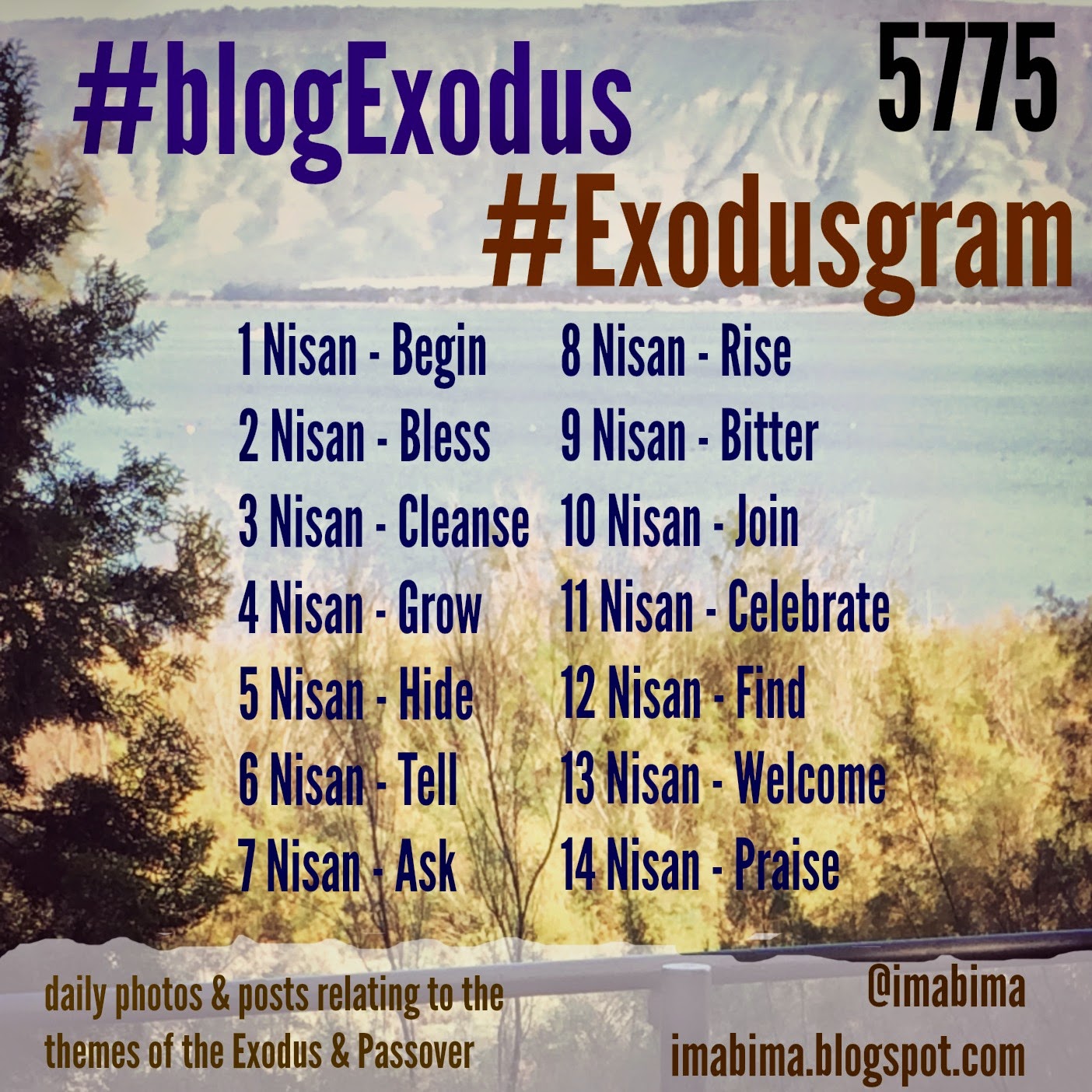
#blogExodus 2: Bless

#blogExodus 5775 topicsA couple weekends ago, I was doing rather a lot of the opposite of blessing. My husband’s squadron had decided that it was sending a gaggle of instructors and students out of town in an effort to find better flying weather. The issue is that the decision was made on Friday that the trip would begin on Monday, which meant that there was no time during the workweek for my husband and his colleagues to make the necessary lodging and other logistical arrangements.

Our weekend was interrupted over and over again by the buzzing of my husband’s cell phone as everyone tried to bring the plans together by text message. Each new message took me further along the path from “mildly annoyed” to “irked” to “cursing the OPSO, the squadron, and the Navy with remarkable relish and far-ranging creativity.” By Sunday night, I was irritated with my husband for having the gall not to join me in my excoriation of his superiors and minute, trenchant analysis of their shortcomings both personal and professional.

“You know,” I finally grated at him, “sometimes I just want to hear that you think the situation sucks, too.”

He continued folding laundry for a few beats before speaking. “I’m not thrilled about how this is playing out, either, but there is a limit to how much I can let myself think that it sucks and still be able to do my job.”

In that moment, understanding broke through my annoyance, and I was ashamed. What I had been telling myself was companionable commiseration over a crappy set of circumstances was being received as a shove off balance. I had, in turn, misinterpreted my husband’s need to maintain an even keel as a frustrating lack of acknowledgement of my efforts to vent “with” him, never mind that he never expressed a desire to vent in the first place.

Now I have an understanding that I didn’t have before, thus proving that there is still more to learn even after almost a decade of having a significant other on active duty in the Navy. Next time we run into one of these not-uncommon military inconveniences, I’ll know better, and that insight will feel like a blessing.

Baruch atah, Adonai, chonein hadaat. Blessed are You, Adonai, who graces us with knowledge.


#blogExodus, the brainchild of Rabbi Phyllis Sommer, invites participants to chronicle the weeks leading up to Passover through blog posts, photos, and other social media expressions.


2014 in a Dozen Photos: January-April

Now that we’re a week into 2015, I feel a belated urge to offer up a neatly-wrapped version of my 2014 — you know, the kind of bloggish year-in-review that those writers on top of their game presented in the dwindling days of December. If you’re looking for evidence of grand, probing contemplation of the past year and its moments of deep significance, I’m afraid you’ll be disappointed in my quick-and-dirty version of a year-end wrap-up.

I have selected one photo from each month of 2014 for a collection of twelve vignettes. These dozen snapshots will not present anything resembling a comprehensive look back, not least because there were a number of months in which lots of things were going on and I [arbitrarily decided that I] may only choose one picture. These pictures aren’t necessarily the most important or best artistically or any other superlative from each month. Still, each jumped out at me for some reason, so we’ll go with that and try to keep the analysis to a minimum.

January

January 2014: Pensacola Blizzard

This dusting of snow completely shut down our area for three full days.

The first month of 2014 brought something rarely seen in the steamy, Southern city of Pensacola, Florida: frozen precipitation. Although we grew up rolling our eyes at the way the DC area flails when it snows, even that looks like steely-eyed competence when compared to the Florida panhandle response. Of course, snow happens so rarely here that one can hardly blame the locality for investing in hurricane prep rather than plows, salt, and gravel. It was fun having my husband home for three unanticipated “snow days” from this single dusting, and we indulged in wax log fires and obsessive jigsaw puzzling.

February

February 2014: Peacock up a tree

A denizen of the Gulf Breeze Zoo surveys his domain from above.

Any semblance of a Floridian winter evaporated quickly, so we were soon enjoying “spring” with outdoor activities and strolls through the Gulf Breeze Zoo. I had no idea that peacocks were even capable of getting up into trees; I’d always thought of them as ground-dwelling birds, akin to fancy chickens.

March

March 2014: Chag Purim Sameach!

Chemistry geek alert: “Queen Ester,” at your service. (Not pictured: the whiskey flask in my back pocket.)

March brought the Jewish month of Adar II, which brings Purim! Purim is one of the most fun, carnivalesque holidays on our calendar, and its celebration involves reading the Book of Esther, dressing in costume, and imbibing spirits. I let my geek flag fly with a punny “Queen Ester” costume: each molecule on my shirt is a different ester, which are often responsible for a particular fragrance.

April

April 2014: Backyard Blue Angels Practice

We have an excellent view of the Blue Angels’ twice-a-week practices from our backyard.

In order to minimize my husband’s commute to the flight line, we chose to live very close to NAS Pensacola. One of the advantages (or disadvantages, depending on how one is disposed toward the “sound of freedom”) is that we essentially get a free air show from the Navy’s flight demonstration squadron twice a week throughout much of year. I like the Blue Angels, despite the fact that working around their practices is a pain for my husband and his fellow instructor pilots on base. It gives me a warm fuzzy that Pensacola natives, by and large, take a great deal of pride in “their Blues” even if they have no official military affiliation.

#BlogExodus 3: Enslave

#BlogExodus promptsI am having trouble with this prompt. Although the holiday of Passover requires us to see ourselves as having personally been freed from slavery in Egypt, I am loath to use “enslaved” to describe any aspect of my life in the United States, a country where I enjoy personal, political, and religious freedom largely unprecedented in history. In a world where actual human trafficking and slavery still poison the lives of real people, anything I could say about enslavement in my own life feels like hyperbole to the point of absurdity.

With that in mind, it’s a good thing I have teachers who can help me to see that the concept of metaphorical or spiritual enslavement can provide a useful lens through which to view parts of our lives that have become tangled. Rabbi Rachel Barenblat’s post on today’s #blogExodus prompt acknowledges her own difficulty with using such a strong word as “enslaved” (“And usually it’s not a term I would use,” she writes) to describe a potentially unhealthy relationship with the Internet, email, and our myriad digital distractions. When they control us, we are — metaphorically — enslaved.

Reading Rabbi Barenblat’s take has helped me get past my initial strong hesitation about how today’s prompt could possibly apply to my own life. I can see where the way I think about my relationships with some things in my life have me entangled, or feeling other than free.

Take my husband’s daily flight schedule, for instance. It is a fact of military aviation life that we do not find out what Sampson is doing on a given day until about five o’clock the evening before. Depending on how the “sked” is written, we might find out this evening that he has a brief just twelve hours later at 5:00 AM, or we might see that they switched him to nights and he won’t be home until 10:00 PM. It is what it is, and mostly we roll with the uncertainty, despite the difficulty it presents for making dinner plans with anyone in advance.

Lately, however, I have noticed myself getting a little too caught up in it, allowing my own mood to be dictated by whether my husband has what I see as a favorable schedule. That ought to be a signal to me to loosen my grip, take a deep breath, and disentangle my emotional state from this thing over which I have no control. If I can shift my focus away from my frustration at the constant flexibility required of us, I think I’ll find that I feel less like a slave to the exigencies of squadron scheduling.


#BlogExodus, the brainchild of Rabbi Phyllis Sommer, invites participants to chronicle the weeks leading up to Passover through blog posts, photos, and other social media expressions.

How do Military Families Find Spiritual Homes?

Rabbi Ruth Adar, the “Coffee Shop Rabbi,” recently wrote up a fantastic guide to integrating with one’s synagogue community. Although some of the details and explanations are specific to Jewish congregations, I suspect people of many faiths would find Rabbi Adar’s tips applicable to the challenge of finding a place in a religious community — synagogue, church, or otherwise.

We military families face the task of fitting in with a new congregation more often than the average bear, perhaps every two or three years (or even more frequently, as in the case of rapid-fire PCS moves during periods of training). If we don’t make a place for ourselves in the community quickly, it might not happen at all. When we do succeed in finding a spiritual “home,” a place where we feel welcome and invested and connected, the next set of orders seems to come all too soon. Off we go to start the process at a brand-new duty station, to be the “new kids” yet again.

Although the challenge of finding a new synagogue, church, or other group exists for all military families who desire participation in a communal religious setting, I imagine that the process can look pretty different for people of other faiths and denominations. My neighbor, a Navy wife and a member of the Church of Jesus Christ of Latter-day Saints, told me1 yesterday that one of the things she appreciates about her religious community is that the strong central authority and organization means that by the time her family arrives at a new duty station, all of their church records have been automatically transferred and a place in their new ward has been prepared for them. Since their ward is assigned based on geographic location, the notion of “shul shopping” or “church hopping” to find a congregation at a new duty station is foreign to them.

My neighbor’s experience is nothing like ours. She was surprised to learn that Judaism doesn’t have an equivalent to the LDS Prophet/President or the Catholic Pope or any single head of the religion. In her church, a strong, centralized authority ensures a consistency in each local Mormon ward that she finds comforting. In our religion, every synagogue has its own unique flavor or vibe, even within the same movement. I love that variation, and I feel that each synagogue’s harmony contributes to the joyful sound of the greater Jewish community, even if it’s not the place that winds up being “home” for us.

We don’t always have a wide choice when it comes to local Jewish congregations, though. We’re positively giddy when the Navy sends us someplace where there is more than one synagogue within an hour’s drive. We have some Jewish Air Force friends whose current duty station doesn’t have any kind of Jewish community within hundreds of miles, so we consider ourselves extremely lucky when we have any kind of Jewish communal life available to us. When we happen to find that the available local community is a good fit, it’s truly a bonus worth celebrating.

So I’m curious: If you’re part of a military family, how do you go about finding your spiritual home at a new duty station?

Is it as simple for you as it is for my neighbor, or do you find yourselves visiting lots and lots of different congregations before you settle on one? Do you think Rabbi Adar’s tips are relevant for your own “congregation integration” process, even if you’re not Jewish?


1. If I’m getting any of the details wrong, I apologize. I am not an LDS expert, and any mistakes are the result of my own misunderstanding.

#BlogElul 21: Change, Part II

#BlogElul 2013I do not always deal with change gracefully. I have a tough time with upheaval and disruption in my routine. I may transform, briefly and without much warning, into Grumpy McRageface. I have been known to throw things (though never at anyone… so far).

So naturally, I married a military man, thus ensuring that my world would get shaken up like a tacky Navy-themed snow globe with every PCS move. Moreover, I married a pilot, which means that not only do we not find out what he’s doing tomorrow until the afternoon or evening before, but even the official flight schedule often proves to be merely a plan from which to deviate. This set-up is less than ideal for my constitution.

I wish I could be as sanguine about change as some of the more resilient military spouses I know. These are the kind of people who thrive on change, who not only meet the challenges of continual transmogrification, but are actually excited about it. They’d get bored if things fell into a dependable routine, whereas I would be ecstatic.

Maybe.

Sometimes I get a flicker of a hint that perhaps I am finally adapting to having to adapt and re-adapt so often. In our most recent move, I found myself feeling eager for the adventure more often as I felt out-of-whack from the process of dismantling our life, packing it up, and starting over someplace new. Our Jewish tradition has some advice for how to deal with a change of location over which we have no control, and we find it in the person of Abraham. When God said “Lekh-lekha, go forth,” he trusted that the uprooting of his life from all he had known would wind up being a good change.

I need to trust that the changes my future holds will also turn out for the best.


#BlogElul, the brainchild of Rabbi Phyllis Sommer, invites participants to chronicle the month leading up to the Jewish High Holy Days through blog posts, photos, and other social media expressions.